
Discover Finland from the Driver’s Seat
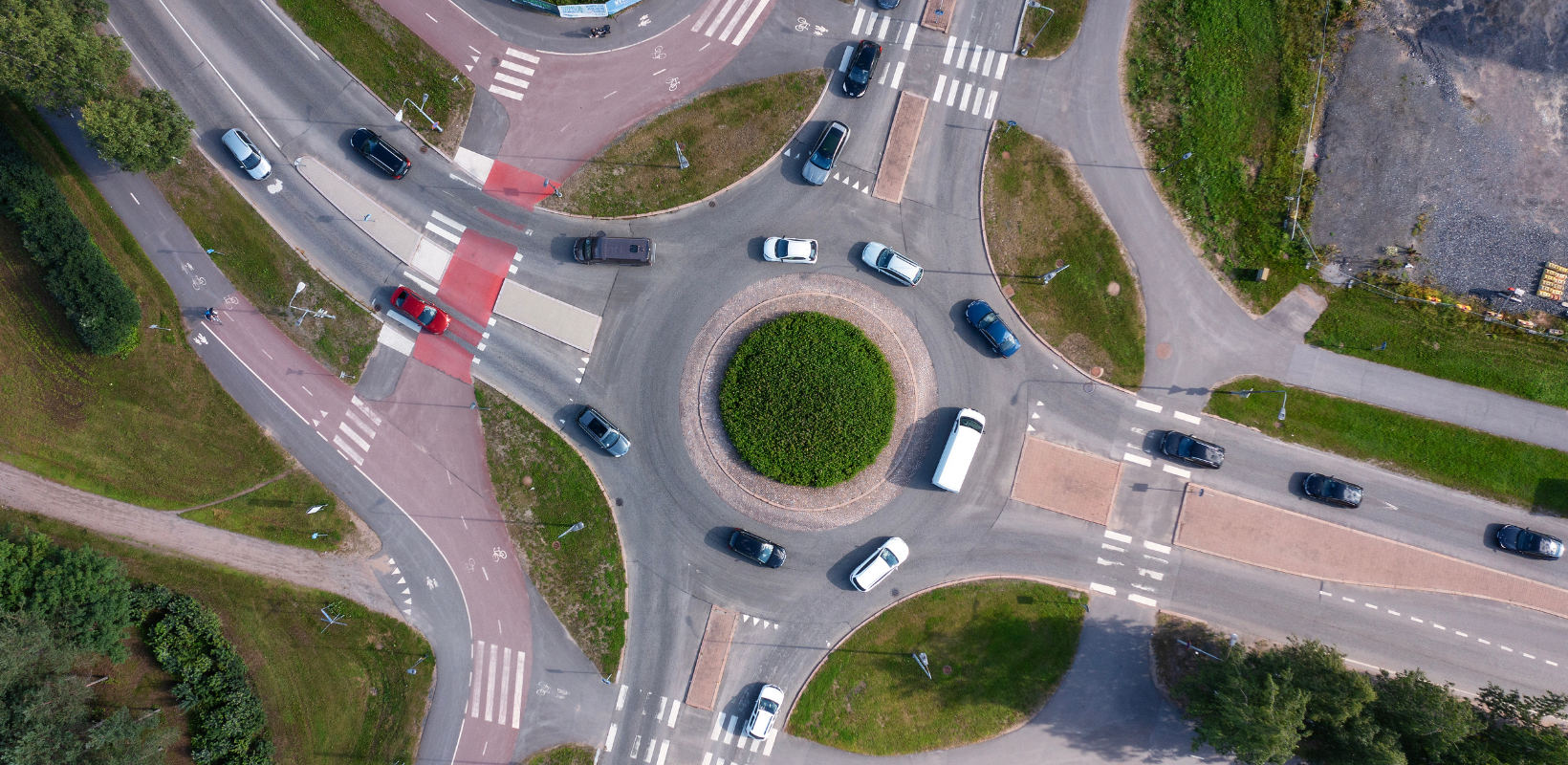
While walking, cycling, and public transport are often convenient ways to get around Finland, driving offers the freedom to explore the country’s thousands of kilometers of roads, from Ivalo in the north all the way to Helsinki in the south.
Maybe you’ve already passed your driving test in your home country and are wondering if that means you can drive here in Finland? And maybe you’re nervous about the rules of the road being different? This guide will help you understand the key information you need to know before getting behind the wheel in Finland.
Are you ready to drive in Finland?
- Already have a licence?
It depends where your driving licence was issued as to what you need to do next. There is a step-by-step guide on what to do depending on where your licence was issued on the Traficom website here: Exchanging a foreign driving licence for a Finnish driving licence | Traficom or you can read more on our website here Driving in Finland: What Immigrants Need to Know About Exchanging a Driver’s License – Oulu
Note: Where it says, ‘after you have moved permanently to Finland’, this does not refer to having a permanent residence permit, but from when you first register a municipality with Digi- ja väestötietovirasto (DVV).
- Don’t have a licence?
In Finland, there are a mandatory amount of driving lessons you must have before you can attempt your driving exam. First, you need to apply for a driving licence permit and then complete the required training. If this is your first driving licence, you must complete 4 theory lessons (EAS training). In addition, you must complete at least 10 driving lessons and 8 hours of risk recognition training, which includes 4 hours of theory instruction and 4 hours of driving instruction. If you take the driving test on or after 1 October 2026, the risk recognition training must meet the new requirements, increasing from 8 hours to 12 hours.
After you have completed the mandatory training, you need to pass a theory test and a practical driving test. More detailed information about these processes can be found on the Traficom website here: Obtaining a driving licence for a passenger car | Traficom
- Looking to buy a car?
If you are buying your own car, there are a few things to consider. Firstly, ensure you buy it from a reputable dealer so you can trust the car is in good condition.
Once you have purchased a car, you must ensure that it is properly insured before driving it. Motor liability insurance is compulsory in Finland. In Finland, car insurance typically covers the vehicle, not specific named drivers. As a result, family members or friends can usually drive the car with the owner’s permission and remain covered by the insurance. However, insurance terms can vary, so it’s always a good idea to check the policy details with your insurance provider when taking out cover. Vehicle owners are also required to pay an annual vehicle tax. The amount varies depending on the vehicle. See more here: Vehicle tax | Traficom
Most vehicles must undergo regular roadworthiness inspections (known as katsastus in Finnish). It is your responsibility as the owner to ensure the vehicle has a valid inspection, as a vehicle that has not been inspected on time cannot be driven legally. See more here: Vehicle inspection | Traficom
If you are buying a used car, it is a good idea to check its service history, inspection records, and any outstanding taxes or restrictions before completing the purchase.
We asked Erika Kamsula, who holds a degree in vehicle mechanics and a vocational qualification as a spare parts salesperson, for advice on what to consider when buying a secondhand car. Here are some of her top tips.
– When buying a used car, it’s worth paying attention to the service history. Even a car that’s been driven only a little can be prone to problems if maintenance has been neglected.
– In the service history, pay attention to the service intervals. For example, when it comes to changing engine oil, I would consider 15,000 km as the absolute maximum. For cars with a timing belt, also check the replacement interval specified by the manufacturer. Changing the timing belt is sometimes recommended earlier in Oulu.
– If you’re thinking about buying a used car, you shouldn’t just look for the lowest odometer reading. Cars with over 200,000 km may even have fewer expensive repairs ahead than those with less than 200,000 km since costly procedures might already have been done.
– Because of road salt, cars rust more easily in Finland, so when buying a car, it’s worth taking a look at the lower edges and wheel arches as well. Plastic trims often hide early rust.
– In Finland, used cars are usually sold with two sets of tires, summer and winter tires. Besides checking the tread depth of the tires, it’s also a good idea to check the manufacturing date, which you can find on the sidewall of the tire. Tires over 10 years old aren’t as flexible and safe as newer ones.
Finnish Road Rules
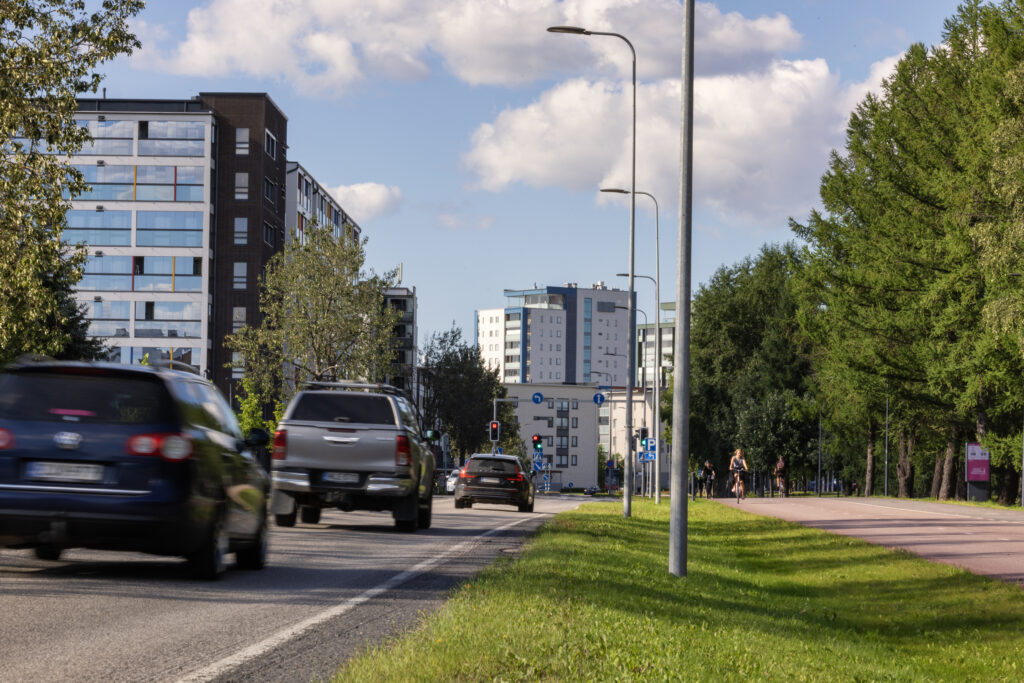
In Finland, cars are driven on the right-hand side of the road. This is like many other European countries. Finland has no toll roads or toll bridges because road construction and maintenance is funded through taxation. Speed limits and distances are given in kilometres, and for reference, 1km = ~0.62 miles.
Speed Limits
Speed limits in Finland are clearly signposted and consistently enforced.
| Type of Road/Area | Typical Speed Limit |
| Built-up area | 30–50 km/h |
| Rural roads | 80 km/h |
| Highways (summer) | 100 km/h |
| Highways (winter) | 80 km/h |
| Motorways (summer) | 120 km/h |
| Motorways (winter) | 100 km/h |
Speed limits in Finland are road-specific, especially on smaller roads, so always pay attention to posted speed limit signs. Finland uses default speed limits whenever no other speed limit sign is displayed. The general speed limit is 50 km/h in built-up areas and 80 km/h outside built-up areas.
A built-up area is indicated by a rectangular sign showing the silhouette of some rooftops. When the same sign is crossed by a red diagonal line, it indicates that you are leaving the built-up area. These signs are sometimes on their own without the speed limit number, so it’s good to be able to recognise them.
Drivers must always follow any posted speed limit signs, as these override the default speed limits.
An overview of all Finnish road signs can be found on the Finnish Transport Infrastructure Agency website: Road Signs — Finnish Transport Infrastructure Agency
Winter Driving
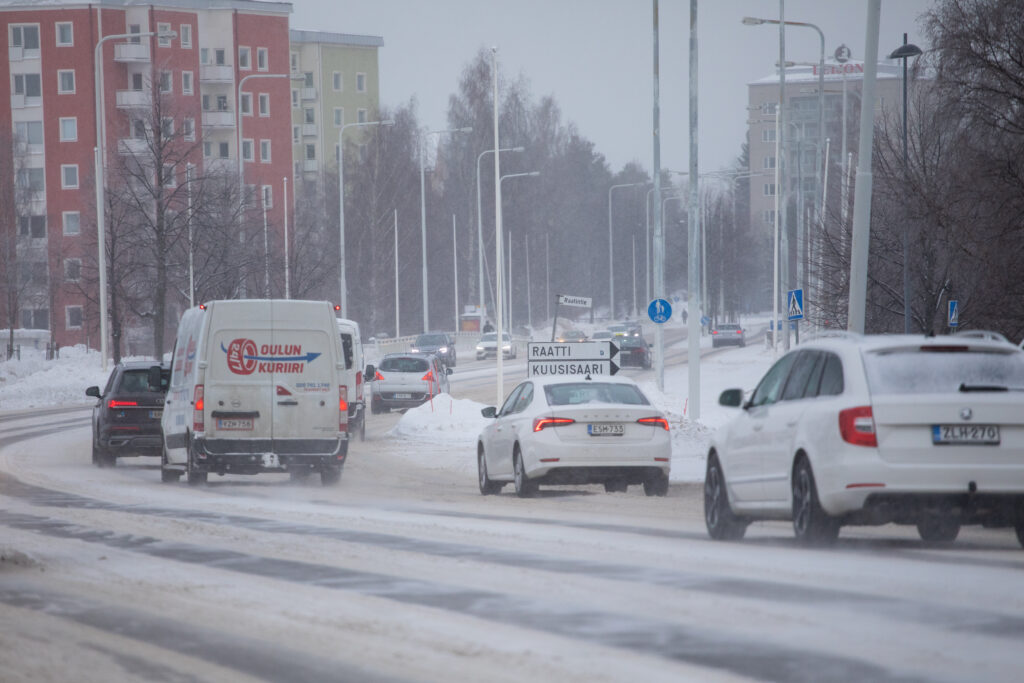
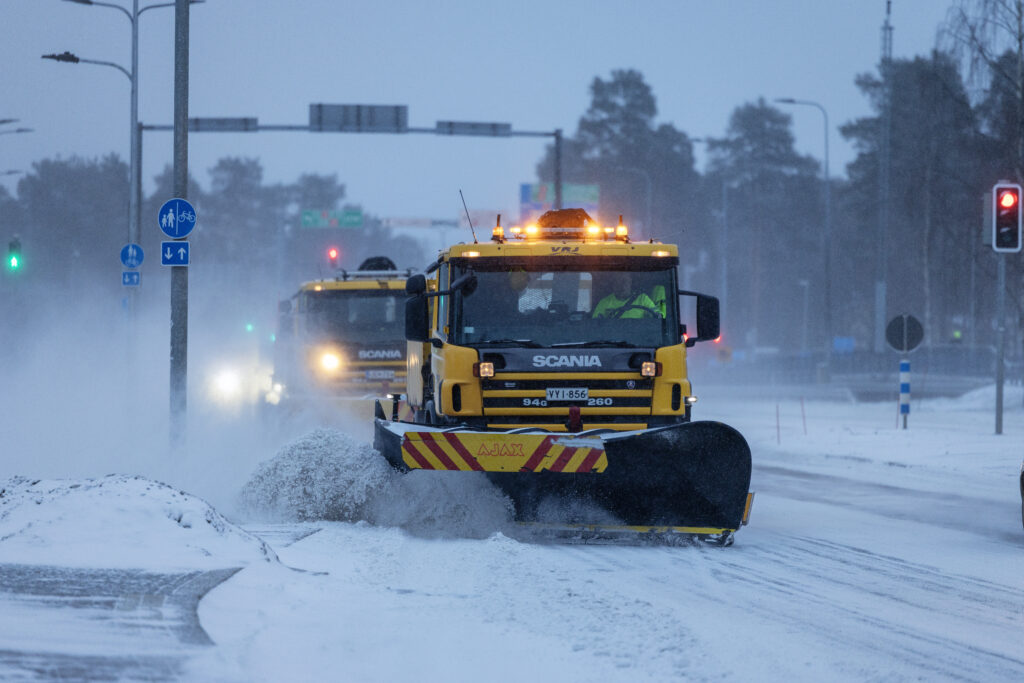
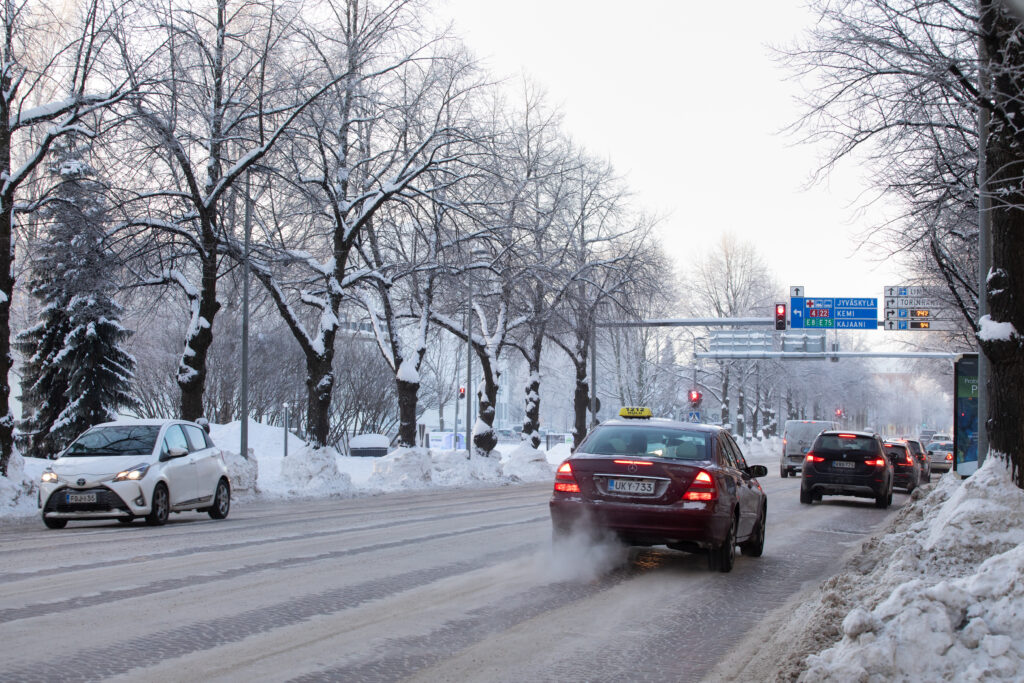
One of the biggest things to consider when driving in Finland is how the driving conditions change in the winter months. With snow and ice on the roads, it is important to take this into account in how you drive. Some key things to consider when driving in the winter months are:
- Before you set off, clear off all ice and snow from your windows, roof, bonnet and lights. You can get a snow brush and ice scraper for relatively cheap at a local store.
- Make sure you keep topped up with enough fuel or battery power. You don’t want to run out and become stranded in the cold conditions.
- Carry a spare set of warm clothes in the car in case of a breakdown. Be prepared for an unfortunate situation.
- Fill up your screen washer fluid regularly with fluid suitable for freezing temperatures. The weather can lead to dirty windscreens that need cleaning more often.
- Ensure you are using winter tyres and that they are in a good condition. The legal minimum tread depth is 3 mm, but 4–5 mm is safer.
Changing to use winter tyres is mandatory between 1st November and 31st March each year, or earlier/later if road conditions require it. Winter tyres can be studded or non-studded. Non-studded winter tyres are often called friction tyres. For more information about the requirements of winter tyres, check the Finnish Road Safety Council website: Car tyres — Check your car tyres — Liikenneturva
Another important consideration when driving in winter conditions is that braking and stopping distances can be significantly longer, even if your vehicle is fitted with winter tyres. For this reason, it is essential to leave a greater distance between your car and the vehicle in front than you would under normal driving conditions.
Drivers should also be aware of the risk of skidding and aquaplaning (hydroplaning) on wet, slushy, or icy road surfaces. Advice on how to reduce these risks, as well as guidance on what to do if you encounter them, can be found on the Finnish Road Safety Council’s website: Difficult driving conditions — Liikenneturva
Parking heater sockets (often called plug-in boxes or engine heating posts) are a common sight in Finland. These outdoor electrical outlets allow drivers to plug in an engine heater before needing to start their car. The heater warms the engine, making it easier to start the car, reducing engine wear, and improving comfort on freezing winter mornings. Many apartment buildings and workplaces provide these sockets, often controlled by a timer to save electricity. You may need to reserve one in a car park you use regularly, as they are usually not open for anyone to use.
It is important to note that these sockets are not the same as electric vehicle (EV) charging points. They are designed to power vehicle heaters rather than charge a car’s battery. Cars equipped with an engine heater have a special connector, usually located behind the front grille, in the front bumper, or under a small cover at the front of the vehicle. Not all cars have this connector fitted as standard. In Finland, many vehicles have an engine heater installed as an optional extra, while others may require one to be added afterwards. If a car does not have an engine heater system installed, it cannot be connected to a parking heater socket.
It is also worth noting that in Finland, vehicles are required to use lights whenever they are being driven. Most modern cars are equipped with daytime running lights, which may turn on automatically during daylight hours. In reduced visibility, such as during snowfall, heavy rain, fog, or darkness, drivers should use their headlights to ensure they can see and be seen by other road users. On unlit roads in clear conditions, high beam headlights can be used to improve visibility further. However, drivers should switch off the high beam headlights when approaching or following another vehicle to avoid dazzling other road users.
Generally, high beam headlights are not effective in fog or heavy snowfall and can actually reduce visibility by creating glare for the driver. During these conditions, fog lights provide better visibility and are a safer option.
Road Safety
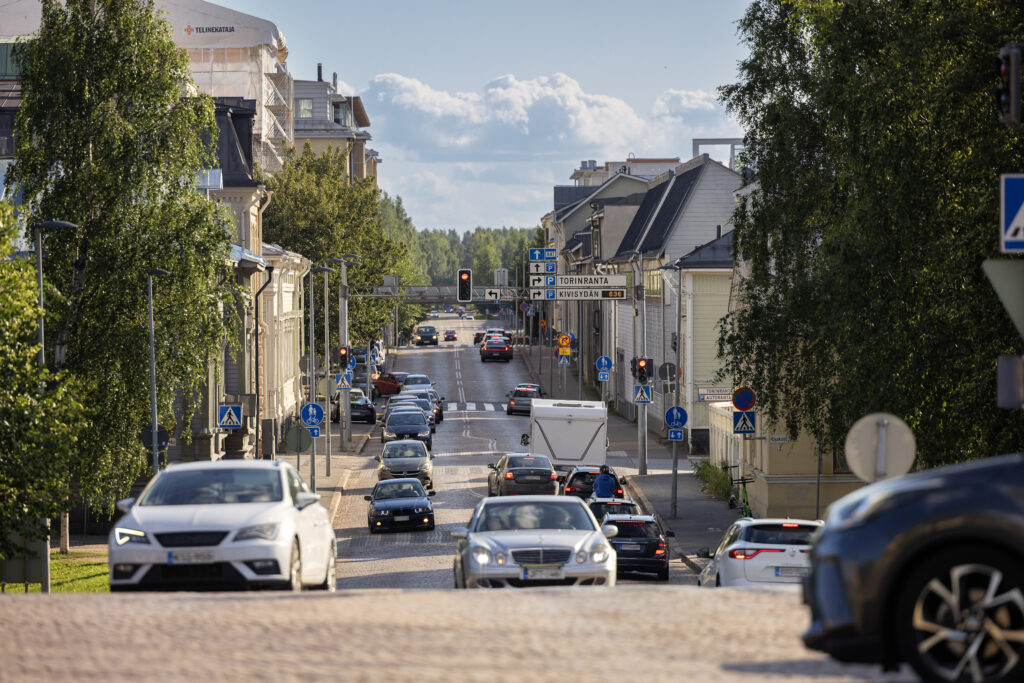
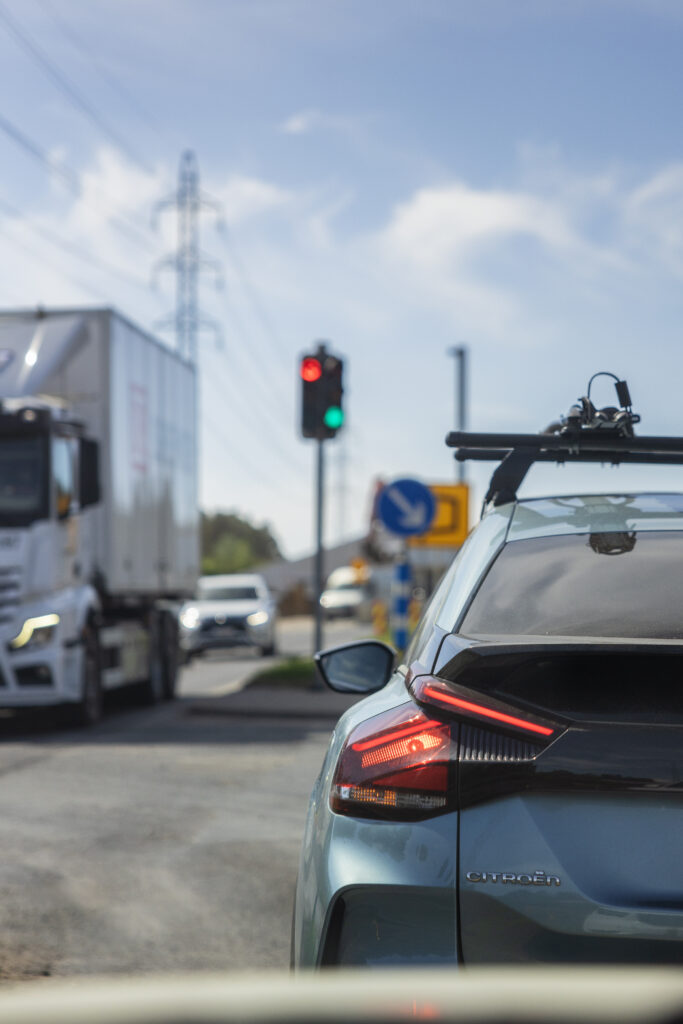
On the roads in Finland, pedestrians and cyclists have right of way, so its very important to be aware of them at crossings and traffic lights. If is very common for people to assume cars will stop for them if they are crossing the road. This may be different from in other countries, so it is very important to be paying close attention to who is on the pavement beside the road and where they may want to cross.
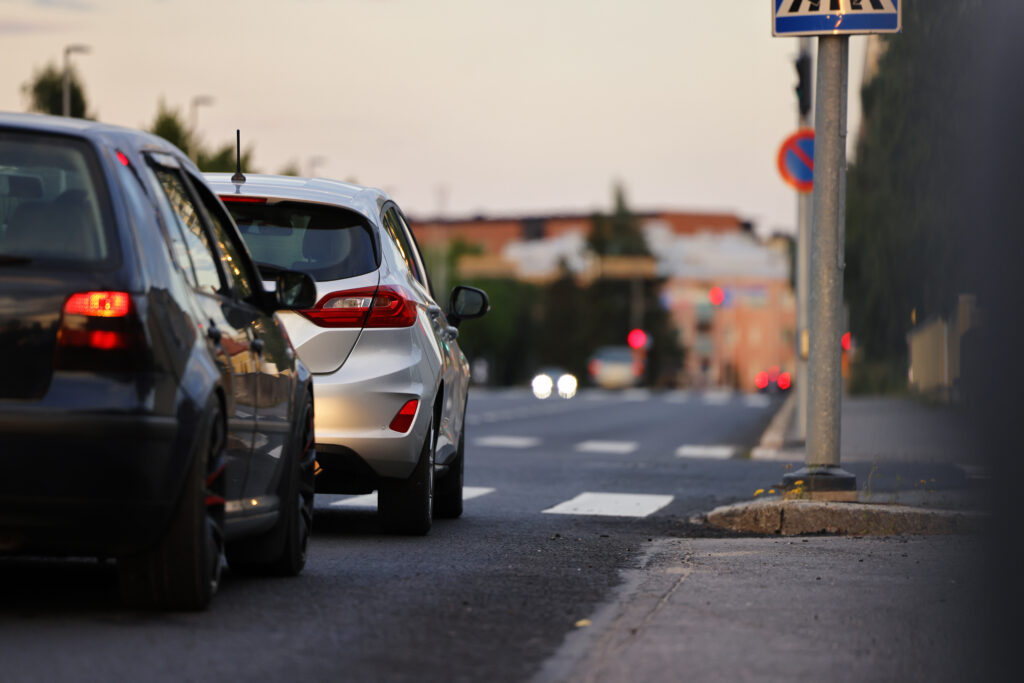
Designated crossings have a sign and white stripes painted across the road. Some traffic lights will also be green for pedestrians when you are turning right or left at a junction, sop pay close attention here too.
For more information with handy diagrams to show different situations with when to give way, see the Finnish Road Safety Council website: Do you know the rules of the road? — Finnish Road Safety Council
Not only might you need to give way to people, there may be another obstruction in the road if you venture outside of the city in your car. Wildlife is also commonly seen on and beside the road, the most common being reindeer if you are driving in Lapland, but moose have been known to cause a nuisance too.
If you see wildlife close to the side of the road, take extra care and drive more slowly, because wildlife can be unpredictable and run into the road at any moment. If they are stopped in the road, you may need to wait behind them until they move or until there is safe place to go around them. Avoid going round them if you are on a bend and cannot see if there is oncoming traffic, or if there is not enough room to go around them and still leave some distance between them and the vehicle. Leaving plenty of space is important so the car doesn’t cause distress to the wildlife.
Remember, you are driving through their home, so be considerate, and if you do unfortunately hit an animal, call 112 so they can help direct you what to do next.
Parking Rules
There is something you might need to use every week but have never seen before – a parking disc.
These are a way of showing when you parked in a car park for officials to know how long your car has been there. When you arrive, you indicate the time on the wheel by lining up the arrow with the correct time using the 24 hour clock. You can round to the closest ten minutes, it doesn’t have to be exact to the minute. Then you place the disc in the inside of your windscreen on your dashboard so it is visible from outside of the car.
You can purchase parking discs from stores, or sometimes children make them at daycare or school for their parents to use. If you rent a car, it often already has a disc attached to the inside of the windscreen or there will be one in the car somewhere else, e.g. the glovebox.
You need to check local parking signs to see whether the disc is in use, or if you need to purchase a ticket. Sometimes car parks do require you to buy a ticket during certain times on certain days. If you see a sign in a car park showing different times, this can indicate the need to buy a ticket, or the time limit in which you can stay parked there.
You can find examples of parking signs and explanations of how to read the signs on the City of Oulu website here: Parking Traffic Signs | Parking | City of Oulu
Other Important Rules
Here are some more important rules you need to know about:
- It is mandatory for every passenger in a vehicle to wear a seatbelt.
- Children under the age of 3, and children over the age of 3 who are under 135 cm tall, must use an appropriate child restraint or car seat.
- It is compulsory to carry a warning triangle in your vehicle in case of a breakdown.
- It is illegal to hold or use a mobile phone while driving. If you need to make a call, use a hands-free system or stop in a safe place first.
- Drivers and passengers on motorcycles and mopeds must wear an approved safety helmet.
- The legal blood alcohol limit for drivers is 0.05%. However, even small amounts of alcohol can affect your judgement, reaction times and driving ability, so if you are driving, it is safest not to drink any alcohol at all.
- Pedestrians are encouraged to wear a reflector when walking in dark conditions to improve visibility, so keep an eye out for those.
This list is not exhaustive, and this article is not long enough to include everything. Therefore, it is important you familiarise yourself with the local laws and driving rules using official sources such as Drivers and Vehicles | Traficom and Finnish Road Safety Council — Liikenneturva.
However you choose to get around, we hope your journey goes smoothly.
Text by: Sophie Platt